Adapted from the AAC&U VALUE Rubrics and acknowledged with thanks. See Assuring Graduate Capabilities /
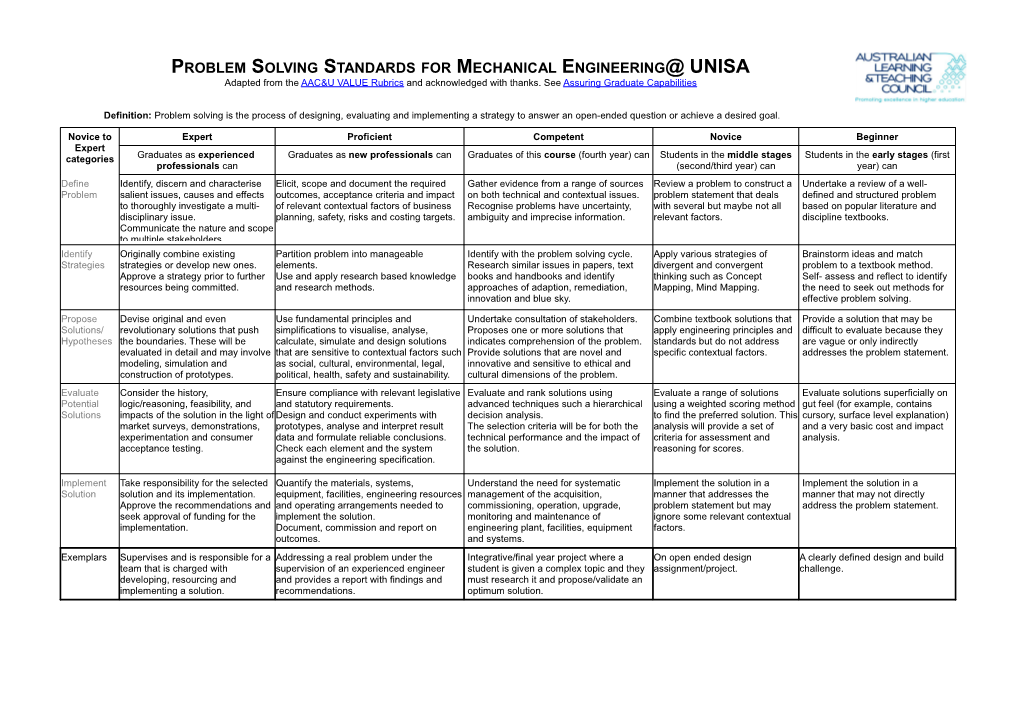
Definition:Problem solving is the process of designing, evaluating and implementing a strategy to answer an open-ended question or achieve a desired goal.
Novice to Expert categories / Expert / Proficient / Competent / Novice / BeginnerGraduates as experienced
professionals can / Graduates as new professionals can / Graduates of this course(fourth year) can / Students in the middle stages(second/third year) can / Students in the early stages(first year) can
Define Problem / Identify, discern and characterise salient issues, causes and effects to thoroughly investigate a multi-disciplinary issue.
Communicate the nature and scope to multiple stakeholders. / Elicit, scope and document the required outcomes, acceptance criteriaand impact of relevant contextual factors of business planning, safety, risks and costing targets. / Gather evidence from a range of sources onboth technical and contextual issues.
Recognise problems have uncertainty, ambiguity and imprecise information. / Review a problem to construct a problem statement that deals with several but maybe not all relevant factors. / Undertake a review of a well- defined and structured problem based on popular literatureand discipline textbooks.
Identify Strategies / Originally combine existing strategies or develop new ones.
Approve astrategy prior to further resources being committed. / Partition problem into manageable elements.
Useand apply research based knowledge and research methods. / Identify with the problem solving cycle.
Research similar issues in papers, text books and handbooks and identify approaches of adaption, remediation, innovation and blue sky. / Apply various strategies of divergent and convergent thinkingsuch as Concept Mapping, Mind Mapping. / Brainstorm ideas and match problem to a textbook method.
Self- assess and reflectto identify the need to seek out methods for effective problem solving.
Propose Solutions/Hypotheses / Devise original and even revolutionary solutions that push the boundaries. These willbe evaluated in detail and may involve modeling, simulation and construction of prototypes. / Use fundamental principles and simplifications to visualise, analyse, calculate, simulate and design solutionsthat are sensitive to contextual factors such associal, cultural, environmental, legal, political, health, safety and sustainability. / Undertake consultation of stakeholders.
Proposes one or more solutions that indicates comprehension of the problem. Provide solutions that are novel and innovative and sensitiveto ethical and cultural dimensions of the problem. / Combine textbooksolutionsthat apply engineering principles and standards but do not address specific contextual factors. / Provide a solution that may be difficult to evaluate because they are vague or only indirectly addresses the problem statement.
Evaluate Potential Solutions / Consider thehistory, logic/reasoning, feasibility, and impacts of the solutionin the light of market surveys, demonstrations, experimentation and consumer acceptance testing. / Ensure compliance with relevant legislative and statutory requirements.
Design and conduct experiments with prototypes, analyse and interpret result data and formulate reliable conclusions.
Check each element and the system against the engineering specification. / Evaluateand rank solutions using advanced techniques such a hierarchical decision analysis.
The selection criteria will be for both the technical performance and the impact of the solution. / Evaluatea range of solutions using a weighted scoring method to find the preferred solution. This analysis will provide a set of criteria for assessment and reasoning for scores. / Evaluate solutions superficially on gut feel (for example, contains cursory, surface level explanation) and a very basic cost and impact analysis.
Implement Solution / Take responsibility for the selected solution and its implementation. Approve the recommendations and seekapproval of funding for the implementation. / Quantify the materials, systems, equipment, facilities, engineering resources and operating arrangements needed to implement the solution.
Document, commission and report on outcomes. / Understand the need for systematic management of the acquisition, commissioning, operation, upgrade, monitoring and maintenance of engineering plant, facilities, equipment and systems. / Implement the solution in a manner that addresses the problem statement but may ignore some relevant contextual factors. / Implement the solution in a manner that may not directly address the problem statement.
Exemplars / Supervises and is responsible fora teamthat is charged with developing, resourcing and implementing a solution. / Addressing a real problem under the supervision of an experienced engineer and provides a report with findings and recommendations. / Integrative/final year project where a student is given a complex topic and they must research it and propose/validate an optimum solution. / On open ended design assignment/project. / A clearly defined design and build challenge.