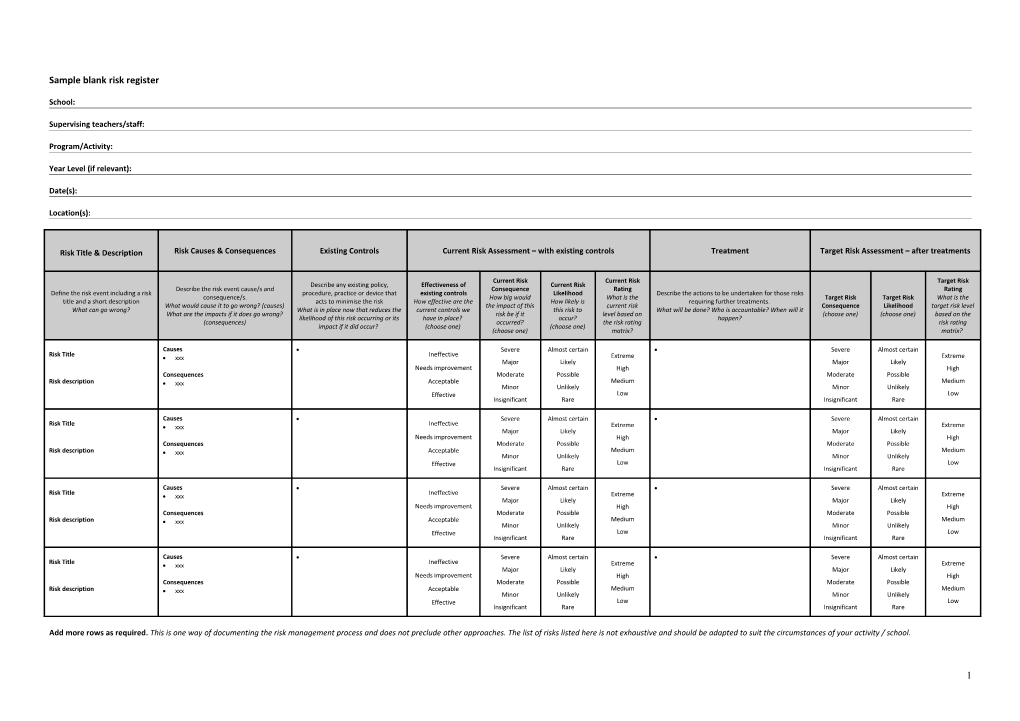
Sample blank risk register
School:
Supervising teachers/staff:
Program/Activity:
Year Level (if relevant):
Date(s):
Location(s):
Risk Title & Description / Risk Causes & Consequences / Existing Controls / Current Risk Assessment – with existing controls / Treatment / Target Risk Assessment – after treatmentsDefine the risk event including a risk title and a short description
What can go wrong? / Describe the risk event cause/s and consequence/s.
What would cause it to go wrong? (causes)
What are the impacts if it does go wrong? (consequences) / Describe any existing policy, procedure, practice or device that acts to minimise the risk
What is in place now that reduces the likelihood of this risk occurring or its impact if it did occur? / Effectiveness of existing controls
How effective are the current controls we have in place?
(choose one) / Current Risk Consequence
How big would the impact of this risk be if it occurred?
(choose one) / Current Risk Likelihood
How likely is this risk to occur?
(choose one) / Current Risk Rating
What is the current risk level based on the risk rating matrix? / Describe the actions to be undertaken for those risks requiring further treatments.
What will be done?Who is accountable?When will it happen? / Target Risk Consequence
(choose one) / Target Risk Likelihood
(choose one) / Target Risk Rating
What is the target risk level based on the risk rating matrix?
Risk Title
Risk description / Causes
- xxx
- xxx
Needs improvement
Acceptable
Effective / Severe
Major
Moderate
Minor
Insignificant / Almost certain
Likely
Possible
Unlikely
Rare / Extreme
High
Medium
Low / Severe
Major
Moderate
Minor
Insignificant / Almost certain
Likely
Possible
Unlikely
Rare / Extreme
High
Medium
Low
Risk Title
Risk description / Causes
- xxx
- xxx
Needs improvement
Acceptable
Effective / Severe
Major
Moderate
Minor
Insignificant / Almost certain
Likely
Possible
Unlikely
Rare / Extreme
High
Medium
Low / Severe
Major
Moderate
Minor
Insignificant / Almost certain
Likely
Possible
Unlikely
Rare / Extreme
High
Medium
Low
Risk Title
Risk description / Causes
- xxx
- xxx
Needs improvement
Acceptable
Effective / Severe
Major
Moderate
Minor
Insignificant / Almost certain
Likely
Possible
Unlikely
Rare / Extreme
High
Medium
Low / Severe
Major
Moderate
Minor
Insignificant / Almost certain
Likely
Possible
Unlikely
Rare / Extreme
High
Medium
Low
Risk Title
Risk description / Causes
- xxx
- xxx
Needs improvement
Acceptable
Effective / Severe
Major
Moderate
Minor
Insignificant / Almost certain
Likely
Possible
Unlikely
Rare / Extreme
High
Medium
Low / Severe
Major
Moderate
Minor
Insignificant / Almost certain
Likely
Possible
Unlikely
Rare / Extreme
High
Medium
Low
Add more rows as required.This is one way of documenting the risk management process and does not preclude other approaches.The list of risks listed here is not exhaustive and should be adapted to suit the circumstances of your activity / school.
1
DET Risk Process
DET Risk Process
1
DET Risk Management Framework - Assessment Tools
Consequence Criteria: This guide provides indicative terms against which the significance of risk is evaluated.
Descriptor / Student Outcomes / Wellbeing and Safety / Finance / Reputation / Operations / StrategicInsignificant /
- Educational outcomes, engagement and wellbeing and pathways and transitionscan be met with workarounds
- Minor injury requiring no first aid or peer support for stress / trauma event
- Small loss that can be absorbed
- Internal impact (no external impact)
- School operations continue with slight interruptions to normalactivities
- Goals, targets and key improvement strategies can be delivered withinconsequential impacts
Minor /
- Educational outcomes, engagement andwellbeing and pathways and transitionsachieved but below targets
- Injury / ill health requiring first aid
- Peer support for stress / trauma event
- Loss of ‘consumable’ assets,
- < 2% deviation from budget
- Minor fraud possible
- Adverse comments local community media
- Short term stakeholder dissatisfaction / comment
- Some school operations disrupted
- Minor workarounds return school tonormal operations
- Minor workaround need to be implemented to deliver the SSP goals,targets and key improvement strategies
Moderate /
- Student’s overall levels of Literacy and Numeracy static
- Increasing truancy
- Partial achievement of targetedpathways and transition
- Injury / ill health requiring medical attention
- Stress / trauma event requiring professional support
- Loss of assets
- 2% - 5% deviation from budget
- External audit management letter
- External scrutiny e.g. VAGO
- Adverse state media comment
- Stakeholder relationship impacted
- Key school operations temporarily disrupted
- School leadership team meets toreturn school to normal operations
- Constant consultation with key stakeholders needs to be maintained to deliver the SSP goals, targets and keyimprovement strategies
Major /
- National targeted improvements not achieved
- Partial achievement of targeted learning outcomes
- Student dissatisfaction withaccess to pathways/transitions
- Injury / ill health requiring hospital admission
- Stress / trauma event requiring ongoing clinical support
- Loss of significant assets
- 6% - 15% deviation from budget
- External audit qualification on accounts
- High end fraud committed
- External investigation
- Adverse comments national media
- Stakeholder relationship tenuous
- Whole of school operations disrupted
- Assistance sought from RegionalOffice
- Significant adjustment to resource allocation and service delivery required to deliver SSP goals, targets and keyimprovement strategies
Severe /
- Literacy and Numeracy decline
- Student’s engagement and connectedness to the school and their peers is very poor
- Declining number of student options for pathways and transitions
- Fatality or permanent disability
- Stress / trauma event requiring extensive clinical support for multiple individuals
- Loss of key assets
- >15 % deviation from budget
- Systemic and high value fraud
- Commission of inquiry
- National front page headlines
- Stakeholder relationship irretrievably damaged
- Normal school operations cease
- School evacuated
- Regional Office notified
- SSP goals, targets and key improvement strategies cannot be delivered
- Changes need to be made to the SSP
Likelihood Criteria:This guide provides the indicative terms against which the probability of a risk event occurrence is evaluated.
Descriptor / Description / Indicative % / Indicative Frequency / Note:- The Likelihood Criteria refers to the likelihood of the consequence descriptor you have selected i.e. the likelihood of a ‘major’ consequence.
- The Indicative Frequencymay not be relevant when assessing risks related to repeated activities, or when objectives are to be delivered over discrete periods of time. It should not be the sole basis for assessment.
Almost Certain / Expected to occur / >95% / Multiple times in the next year
Likely / Probably will occur (no surprise) / 66-95% / At least once in the next year
Possible / May occur at some stage / 26-65% / Once in the next 3 years
Unlikely / Would be surprising if it occurred / 5-25% / Once in the next 5 years
Rare / May never occur / <5% / Once in the next 10 years
DET’s Control Effectiveness: Indicates the self-assessment of control effectiveness.
Controls Effectiveness Rating and CriteriaIneffective /
- The design of controls overall, is ineffective in addressing key causes and/or consequences.
- Documentation and/or communication of the controls does not exist (e.g. policies, procedures, etc.).
- The controls are not in operation or have not yet been implemented.
Needs Improvement /
- The design of controls only partially addresses key causes and/or consequences.
- Documentation and/or communication of the controls (e.g. policies, procedures, etc.) are incomplete, unclear or inconsistent.
- The controls are not operating consistently and/or effectively and have not been implemented in full.
Acceptable /
- The design of controls is largely adequate and effective in addressing key causes and/or consequences.
- The controls (e.g. policies, procedures, etc.) have been formally documented but not proactively communicated to relevant stakeholders.
- The controls are largely operating in a satisfactory manner and are providing some level of assurance.
Effective /
- The design of controls is adequate and effective in addressing the key causes and/or consequences.
- The controls (e.g. policies, procedures, etc.) have been formally documented and proactively communicated to relevant stakeholders.
- The controls overall, are operating effectively so as to manage the risk.
DET’s Risk Rating Matrix: Used to combine consequence with likelihood to determine the overall level of risk.
Risk Rating Matrix / ConsequenceInsignificant / Minor / Moderate / Major / Severe
Likelihood / Almost Certain / Medium / High / Extreme / Extreme / Extreme
Likely / Medium / Medium / High / Extreme / Extreme
Possible / Low / Medium / Medium / High / Extreme
Unlikely / Low / Low / Medium / Medium / High
Rare / Low / Low / Low / Medium / Medium
DET’s Acceptability Chart: Used to decide whether the risk is acceptable, based on the rating calculated.
Extreme = Unacceptable(must havePrincipal / School Council / Regional Officeoversight) / Immediately consider whether the activity associated with this risk should cease. Any decision to continue exposure to this level of risk should be made at Principal/School Council/Regional Office level, be subject to the development of detailed treatments, on-going oversight and high level review.
High = Tolerable
(with ongoingPrincipal Class Officer review) / Risk should be reduced by developing treatments. It should be subject to on-going review to ensure controls remain effective, and the benefits balance against the risk. Escalation of this level of risk to Principal Class Officer level should occur.
Medium = Tolerable
(with frequent risk owner review) / Exposure to the risk may continue, provided it has been appropriately assessed and has been managed to as low as reasonably practicable. It should be subject to frequent review to ensure the risk analysis remains valid and the controls effective. Treatments to reduce the risk can be considered.
Low = Acceptable
(with periodic review) / Exposure to this risk is acceptable, but is subject to periodic review to ensure it does not increase and current control effectiveness does not vary.
Find Risk Management on eduGate
School Cycle - where schools should use risk management
Utilise risk management at all stages of the school cycle, to drive decision making, establish priorities and allocate resources. Risk management should be based on the best information available. Effort expended should be proportionate to the risk and benefits should be balanced against the risk.
PESTLE Analysis - used to establish the context
PESTLE - (political, economic, social, technological, legal, environmental) is a useful tool to analyse the operating environment and to understand any other factors that contribute to it. It may be beneficial to involve your key stakeholders when conducting this type of analysis.
SWOT Matrix - used in risk identification
A SWOT Matrix (strengths, weaknesses, opportunities and threats) is a useful tool to analyse the environment and establish current issues and future risks. It may be beneficial to involve your key stakeholders when conducting this type of analysis.
1