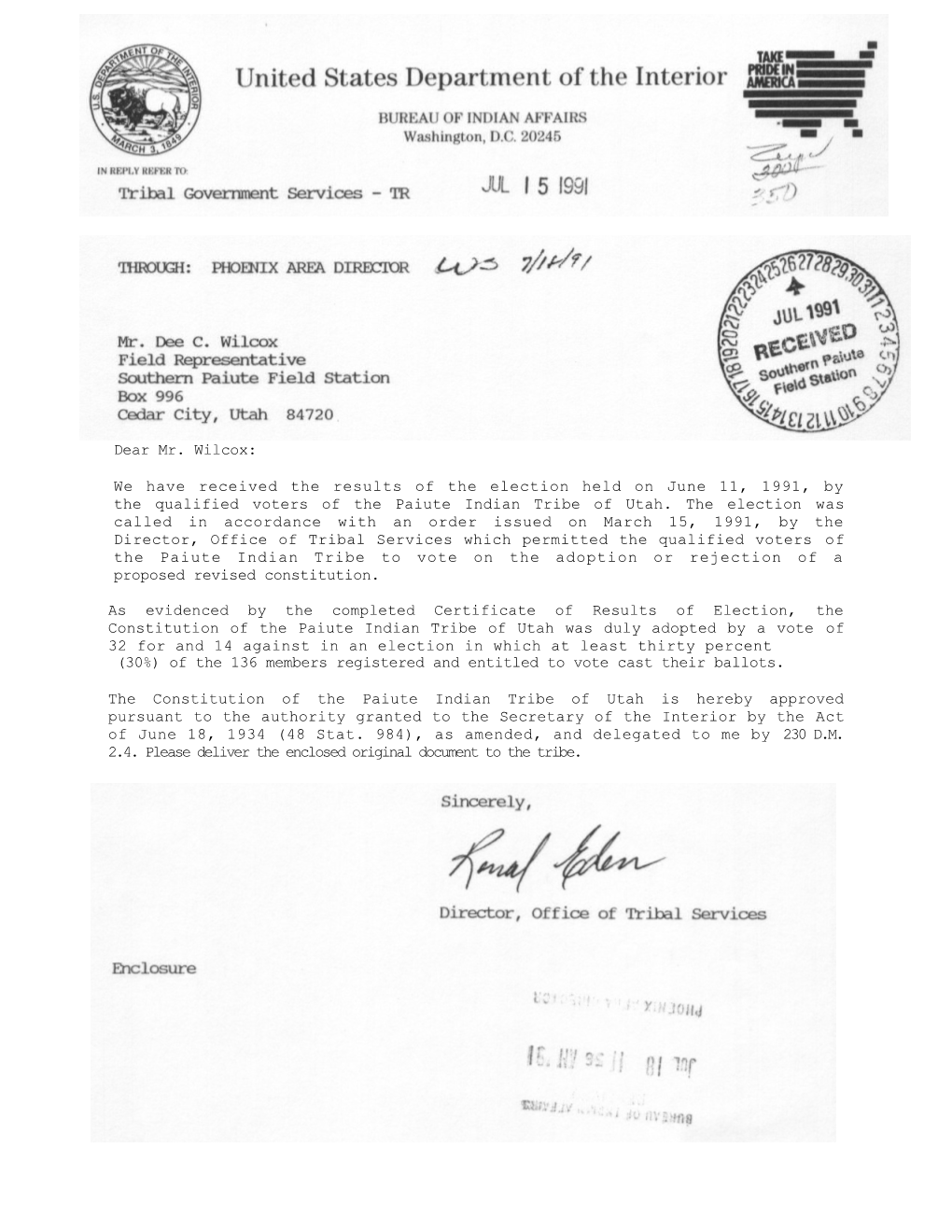
Dear Mr. Wilcox:
We have received the results of the election held on June 11, 1991, by the qualified voters of the Paiute Indian Tribe of Utah. The election was called in accordance with an order issued on March 15, 1991, by the Director, Office of Tribal Services which permitted the qualified voters of the Paiute Indian Tribe to vote on the adoption or rejection of a proposed revised constitution.
As evidenced by the completed Certificate of Results of Election, the Constitution of the Paiute Indian Tribe of Utah was duly adopted by a vote of 32 for and 14 against in an election in which at least thirty percent
(30%) of the 136 members registered and entitled to vote cast their ballots.
The Constitution of the Paiute Indian Tribe of Utah is hereby approved pursuant to the authority granted to the Secretary of the Interior by the Act of June 18, 1934 (48 Stat. 984), as amended, and delegated to me by 230 D.M. 2.4. Please deliver the enclosed original document to the tribe.
We, the members of the Paiute Indian Tribe of Utah, comprised of the five bands of Southern Paiute Indians; the Shivwits, Indian Peaks, Cedar City, Koosharem, and Kanosh Bands, in order to establish a tribal government for ourselves, to better exercise the privileges and powers of self-government, to conserve our tribal and band property, to develop our resources, to preserve Paiute language and culture, to promote the welfare of ourselves and our descendants, and to secure our rights and privileges as members, hereby establish this constitution pursuant to the Act of June 18, 1934, as amended, 48 Stat. 984, and the Act of April 3, 1980, 94 Stat. 317. The Constitution and Bylaws of the Kanosh Band of Paiute Indians approved by the Secretary of the Interior on December 2, 1942, the Constitution and Bylaws of the Shivwits Band of Paiute Indians approved by the Secretary of the Interior on March 21, 1940, and the Constitution of the Paiute Indian Tribe of Utah approved by the Secretary of the Interior on October 8, 1981, are hereby superseded by this constitution which shall govern the Paiute Indian Tribe of Utah and its constituent bands from its effective date.
ARTICLE I - TERRITORY AND JURISDICTION
Section 1.Territory.Pursuant to the Act of April 3, 1980, 94 Stat. 317, the territory of the tribe shall extend to the exterior boundaries of all reservation lands held in trust for the tribe or any of its constituent bands and any other lands heretofore or hereafter acquired by the United States in trust for the tribe or its constituent bands.
Section 2.Jurisdiction.The governmental powers of the Paiute Indian Tribe of Utah, a federally recognized sovereign Indian tribe, shall, consistent with applicable Federal law and this constitution, extend to all persons, subjects, and property, including natural resources, within the exterior boundaries of reservation lands held in trust for the tribe or any of its constituent bands and to any other lands hereafter acquired by the United States in trust for the tribe or its constituent bands.
ARTICLE II - TRIBAL MEMBERSHIP
Section 1.Tribal membership shall include:
(a) Those persons whose names appear on the official revised membership roll compiled pursuant to Sections 4 and 6(a) of the Paiute Indian Tribeof Utah Restoration Act, P.L. 96-227, 94 Stat. 317, and adopted by the Interim Tribal Council on the 13th day of July, 1981, Resolution No. 81-27, Enrollment.
(b) Those who are of at least one-fourth (1/4) degree Paiute Indian blood and who are lineal descendants of those in (a) above.
(c) Those who are adopted by a tribal member if the person adopted meets and verifies the fulfillment of all of the following requirements:
(1) The adoption was granted by a court of competent jurisdiction; and
(2) The applicant is four-fourths (4/4) degree Indian blood from a federally recognized Indian tribe; and
(3) The applicant has resided within the Counties of Millard, Sevier, Iron, Beaver or Washington at least five (5) yearsprior to applying for membership; and
(4) The applicant's name has been submitted to and successfully passed a referendum vote of the tribal membership pursuant to Article XI, Section 2(c) of this constitution.
(d) The lineal descendants of a person who becomes a member by virtue of adoption may become tribal members if said descendants are at least one-fourth (1/4) degree Paiute Indian blood. The adopted children of an adopted member may become members if the adopted child meets the requirements of Section 1(c) of Article II.
(e) For the purposes of this Section "Paiute Indian Blood" is defined as Indian blood derived from any of the five (5) constituent bands.
Section 2.Band Affiliation.An applicant for tribal enrollment shall be affiliated with the same band as the applicant's parents. Where the parents of an applicant are of different bands, the applicant shall at the time of enrollment in the tribe select affiliation with the band of either parent. No person shall be affiliated with more than one band and transfers from one band to another shall not be permitted.
Section 3.Dual Enrollment.Despite the provisions of Section 1, no person who is or becomes enrolled as a member of another tribe may be a member of this tribe.
- 2 -
Section 4.Appeal of Refusal of Membership.Any person denied tribal membership may appeal the denial in accordance with applicable tribal ordinances.
Section 5.Ordinances.The tribal council shall enact ordinances governing adoption, loss or surrender of membership, and future membership; Provided,Thatsuch ordinances are in compliance with this constitution.
Section 6.Membership Roll.The tribal council shall maintain a current membership roll of the tribe which reflects band affiliation, adding the names of persons found eligible for enrollment and deleting the names of deceased enrollees for whom appropriate proof of death has been submitted.
Section 7.Corrections in Roll.Corrections may be made in the official revised membership roll by the tribal council for the purposes of correcting misspellings of names and incorrect listings of blood quantums; Provided,However,Thatthe tribal council may not remove the name of any person listed on the official revised membership roll without the approval of the Secretary of the Interior.
ARTICLE III - CONSTITUENT BANDS
The Cedar City, Kanosh, Koosharem, Indian Peaks, and Shivwits Bands shall constitute the constituent bands of the tribe.
ARTICLE IV - TRIBAL COUNCIL
Section 1.Tribal Council Membership.
(a) The tribal council shall consist of six (6) members, one (1) elected from and by each constituent band at a band election, and the sixth elected as chairperson as set forth below.
(b) The council member from each constituent band shall be elected from among and by the membership of the band eligible to vote and casting ballots in an election called for that purpose. The candidate who receives the highest number of votes in said election shall be a council member and also serve as the chairperson of the band council. The candidate who receives the second highest number of votes in the band election shall serve as band vice-chairperson.
(c) A subsequent election for tribal chairperson shall be held from among those elected to the tribal council. The tribal chairperson shall be elected by the membership of the tribe eligible to vote and casting ballots in a tribal election. The chairperson shall be the representative who receives the highest number of votes in the tribal election for chairperson. The representative receiving the next highest number of votes in a tribal election for chairperson
- 3 -
shall be the vice-chairperson. The council member elected as tribal chairperson shall vacate his or her position as chairperson of the band and serve only as tribal chairperson. The vice-chairman of the affected band shall then serve as band chairperson and shall become the band's representative to the council and exercise all powers
attendant thereto. In order to assume the office of band chairperson, the vice-chairperson must meet the qualifications for office set forth in Article XIV, Section 6, of this constitution.
(d) The tribal council may select either from within its membership or outside of its membership a secretary and treasurer. In the event the secretary or treasurer are selected from outside the tribal council, the officers selected from the outside shall have no power to vote in council proceedings.
(e) The term of office for tribal council members shall be four (4) years. The chairperson shall serve four (4) years.The vicechairperson for the affected band shall serve the same term as a council member elected as tribal chairperson. The tribal chairperson shall vote only in the event of a tie.
(f) In the event a council member is unable to attend a council meeting, the vice-chairperson of the affected band may attend, be counted for purposes of forming a quorum and voting, Provided, Thatthe band chairperson has designated in advance in writing that the vicechairperson is acting as his or her representative at said meeting. This resolution shall not constitute an exception to Article XII - Recall, Removal and Forfeiture as found in this constitution.
ARTICLE V - POWERS OF THE TRIBAL COUNCIL
Section 1.The tribal council, as established in Article IV hereof, shall be vested with all executive and legislative powers of the tribe, including the power to make and implement laws, and including such powers as may in the future be restored or granted to the tribe by any law of the United States, or other authority. In addition to all powers vested in any Indian tribeor tribal council by existing law, the powers of the tribal council shall include the following rights and powers: to employ legal counsel, the choice of counsel and fixing of fees to be subject to the approval of the Secretary of the Interior; to prevent the sale, disposition, lease, or encumbrances of tribal lands, interests in lands, or other tribal assets without the consent of the tribe; and to negotiate with the Federal, State and local governments.
- 1 -
Section 2.The tribal council may impose an annual assessment upon a constituent band or bands to be paid to the tribal government for the operation of tribal services and programs and the maintenance of tribal lands and improvements; Provided,Thatan annual assessment shall not exceed an amount equivalent to fifteen percent (15%) of a band's gross income derived from the use of its lands held in trust by the United States for such band. Tribal council ordinances enacted pursuant to this section shall not be subject to initiative elections.
Section 3.This constitution and the ordinances of the tribal council shall be the supreme law of the tribe and all persons subject to its jurisdiction. The tribal council shall exercise its powers consistent with the limitations imposed by this constitution and Federal law.
ARTICLE VI - JUDICIAL BRANCH OF GOVERNMENT
Section 1.Powers of Court. All judicial powers of the tribe shall be vested in a tribal judiciary, including such powers as may in the future be granted or restored to the tribe by any law of the United States, or other authority, except as limited by this constitution.
Section 2.Jurisdiction.The judicial power of the court shall extend to all suits in law or equity arising under this constitution or tribal ordinances. Decisions of the tribal judiciary shall be binding upon all persons within the jurisdiction of the tribe. The appellate court of the tribe shall be the final and supreme interpreter of this constitution and tribal ordinances.
Section 3.Tribal Judiciary.The tribal judiciary shall consist of a trial court of general jurisdiction and an appellate court.
Section 4.Term of Office and Qualifications.The tribal council shall set forth qualifications for tribal court chief judge, associate judge and appellate judge(s) by ordinance. The tribal council shall appoint persons to fill said positions for a term of four (4) years for chief judge, and two (2) years for associate judge and appellate judge(s) and may renew said appointments at the expiration of the term.
Section 5.Removal. No judge shall be removed except for good cause as defined by tribal ordinance. Prior to removal, the judge who is the subject of a removal action shall receive written notice of the charges against him or her five (5) business days prior to a hearingbefore the tribal council called to consider his or her removal. At the removal hearing,said judge shall have the right to examine witnesses against him or her, shall have the right to call witnesses in his or her own behalf and shall have the right to be represented at his or her own expense, by an individual of his or her choice. An affirmative vote of three (3) members of the council shall be required to remove any judge.
- 1 -
Section 6.Rules of Procedure.The tribal court chief judge shall issue rules of pleading, practice, and procedure applicable to any and all proceedings of the tribal court and appellate court, consistent with the provisions of this constitution. In the event the chief judge fails to establish said rules, the tribal council shall have the authority to establish them.
ARTICLE VII - SOVEREIGN IMMUNITY
Section 1.Suits Against the Tribe in Tribal Courts.The tribe shall be subject to suit for declaratory and injunctive relief in tribal courts by persons subject to tribal jurisdiction for the purpose of enforcing rights and duties established by this constitution, by the ordinances of the tribe, and by the Indian Civil Rights Act, 25 U.S.C. Sections 1301 and 1302.
Section 2.Immunity of Tribal Council Members and Employees.The members of the tribal council and employees acting within the scope of their authority or employment shall be personally immune from suit, and said personal immunity shall extend beyond their term of office for actions occurring during said term.
Section 3.Immunity of Tribe from Suit.Except as provided above, the tribe doesnot waive any right which it has to immunity from suit in the courts of the tribe, the United States or of any state, unless the waiver is expressly authorized by a majority of the tribal council in writing.
ARTICLE VIII - BAND COUNCILS
Section 1.Band Council Organization.Each constituent band shall establish by the adoption of by-laws its own rules of procedure and organizational structure.
Section 2.The powers of the bands as set forth herein shall limit the powers of the tribal council and the tribal council shall pass no ordinancesnor adopt any resolutions infringing on the powers of the bands set forth herein.
(a) To consult with representatives of Federal, State or local governments, businesses, and all others on matters of band interest;
(b) To make contracts, except between it and the Federal, State or local governments, under its own name concerning matters that relate solely to the band;
(c) To conduct business affairs concerning all matters that relate solely to the band;
- 1 -
(d) To manage band enterprises and own and operate businesses;
(e) Subject to applicable Federal laws and regulations, to lease and assign band lands, interests in band lands including water rights, to exchange band lands for lands of equal value, to apply for
Federal grazing permits and to permit or prohibit hunting and fishing on band lands;
(f) To recommend to the tribal council any changes in the constitution;
(g) To elect and recall its representative to the tribal council as provided for in this constitution;
(h) To spend band funds in accordance with a budget approved by the band council after review and comment by the tribal council;
(i) To recommend to the tribal council the disposition of, lease, assignment of tribal lands, or other tribal assets;
(j) To exercise such further powers as may be delegated by the tribal council or this constitution; and
(k) Except for the election and recall of its representatives, to delegate to the tribal council any of the above enumerated powers.
Section 3.Actions of Band Councils.The band councils shall take no action which is inconsistent with this constitution, or ordinances or resolutions of the tribe. The band councils may take action only by resolution or motion.
Section 4.Audit of Financial Records. Each band council shall cause an audit of the band accounts to be conducted annually and shall submit the audit to the tribal council for review. The tribal council shall establish by ordinance the time and manner for receipt of band audits by the tribal council.
Section 5.Band Lands.The phrase "Band lands" as used herein means those lands held in trust for a constituent band by the United States.
ARTICLE IX - DUTIES OF OFFICERSSection 1.The Tribal Chairperson:
(a) Shall be the primary representative of the tribe;
(b) Shall call and preside over meetings of the tribal council;
(c) Shall sign all negotiable instruments, contracts, applications for Federal or other funds, as authorized by the tribal council;
- 1 -
(d) Shall have the right to vote only in the case of a tie, shall be counted for purposes of forming a quorum, and shall have the right to debate;