2
CONTROL STRUCTURES
The Processor Status and the FLAGS Register
The circuits in the CPU can perform simple decision-making based on the current state of the processor. For the 8086/8088 processors, the processor state is implemented as nine bits, called flags, in the Flags register. Each decision made by the 8086/8088 CPU is based on the values of these flags.
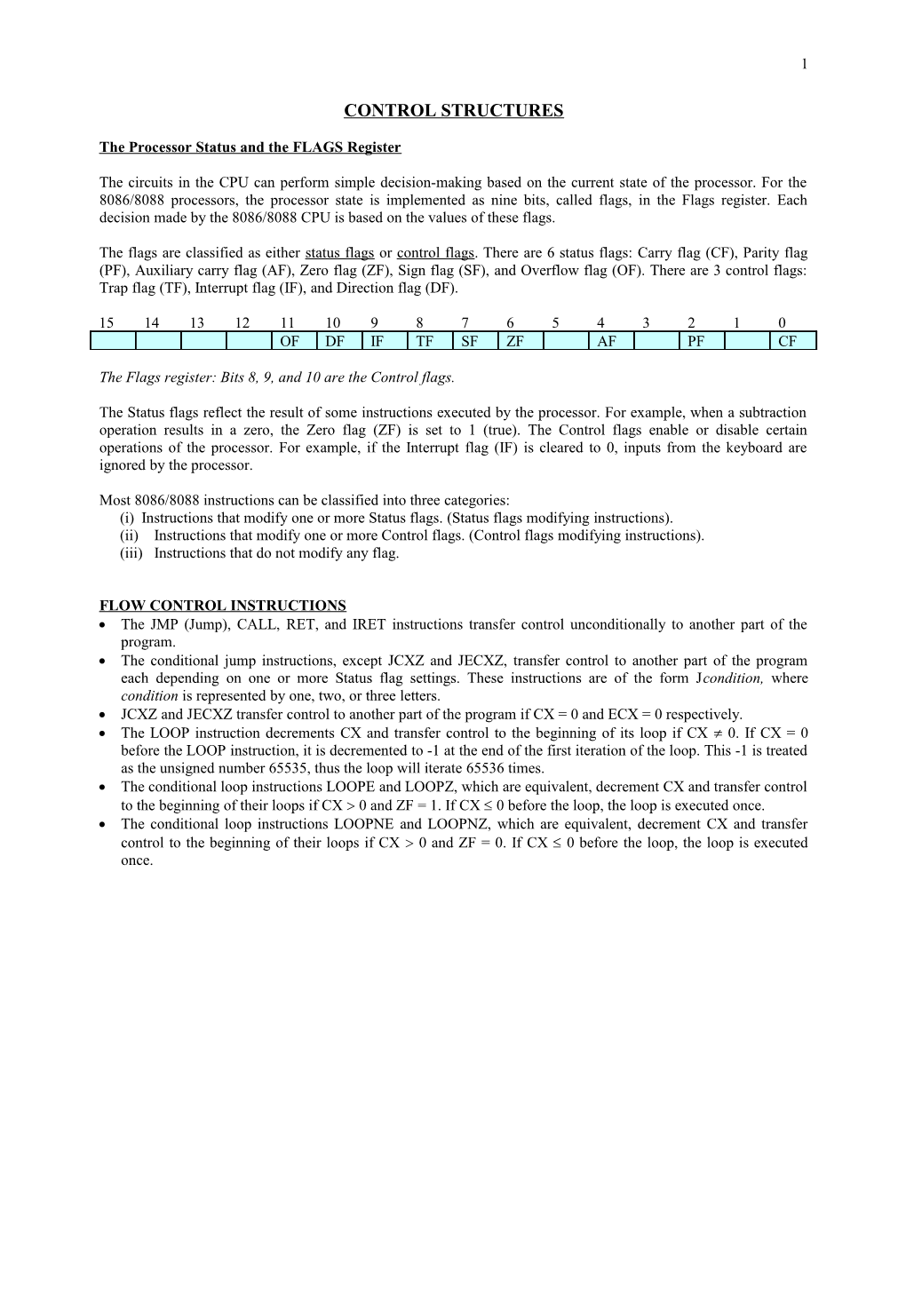
The flags are classified as either status flags or control flags. There are 6 status flags: Carry flag (CF), Parity flag (PF), Auxiliary carry flag (AF), Zero flag (ZF), Sign flag (SF), and Overflow flag (OF). There are 3 control flags: Trap flag (TF), Interrupt flag (IF), and Direction flag (DF).
15 / 14 / 13 / 12 / 11 / 10 / 9 / 8 / 7 / 6 / 5 / 4 / 3 / 2 / 1 / 0OF / DF / IF / TF / SF / ZF / AF / PF / CF
The Flags register: Bits 8, 9, and 10 are the Control flags.
The Status flags reflect the result of some instructions executed by the processor. For example, when a subtraction operation results in a zero, the Zero flag (ZF) is set to 1 (true). The Control flags enable or disable certain operations of the processor. For example, if the Interrupt flag (IF) is cleared to 0, inputs from the keyboard are ignored by the processor.
Most 8086/8088 instructions can be classified into three categories:
(i) Instructions that modify one or more Status flags. (Status flags modifying instructions).
(ii) Instructions that modify one or more Control flags. (Control flags modifying instructions).
(iii) Instructions that do not modify any flag.
FLOW CONTROL INSTRUCTIONS
· The JMP (Jump), CALL, RET, and IRET instructions transfer control unconditionally to another part of the program.
· The conditional jump instructions, except JCXZ and JECXZ, transfer control to another part of the program each depending on one or more Status flag settings. These instructions are of the form Jcondition, where condition is represented by one, two, or three letters.
· JCXZ and JECXZ transfer control to another part of the program if CX = 0 and ECX = 0 respectively.
· The LOOP instruction decrements CX and transfer control to the beginning of its loop if CX ¹ 0. If CX = 0 before the LOOP instruction, it is decremented to -1 at the end of the first iteration of the loop. This -1 is treated as the unsigned number 65535, thus the loop will iterate 65536 times.
· The conditional loop instructions LOOPE and LOOPZ, which are equivalent, decrement CX and transfer control to the beginning of their loops if CX 0 and ZF = 1. If CX £ 0 before the loop, the loop is executed once.
· The conditional loop instructions LOOPNE and LOOPNZ, which are equivalent, decrement CX and transfer control to the beginning of their loops if CX 0 and ZF = 0. If CX £ 0 before the loop, the loop is executed once.
THE JMP INSTRUCTION (Unconditional Jump)
The JMP instruction, whose syntax is:
JMP target
unconditionally transfers control to the target location. There are two major categories of JMP instructions:
(i) Intrasegment jump: A jump to a statement in the same code segment.
(ii) Intersegment or far jump: A jump to a statement in a different code segment.
Intrasegment jumps simply change the value in the IP register. Intersegment jumps change both CS and IP.
Direct and Indirect jumps
A jump can either be direct or indirect. In a direct jump the address of the target is obtained from the instruction itself, i.e., the operand of the JMP instruction is a label. Example:
JMP L2
In an indirect jump the address of the target is obtained from a 16-bit or a 32-bit variable or a general-purpose register referenced by the JMP instruction. Example:
JMP AX
CONDITIONAL JUMP INSTRUCTIONS
Conditional jumps are of the general form:
Jcondition StatementLabel
where (i) condition is one, two, or three letters (ii) the StatementLabel must in the current code segment and should be within -128 to +127 bytes from the conditional jump instruction.
How the CPU implements a conditional jump
Except for the JCXZ (Jump if the value in the CX register is zero) and JECXZ (Jump if the value in ECX register is zero) instruction, every conditional jump instruction must follow a status-flag modifying instruction, either immediately or otherwise. It is the settings of the flags by this status-flag modifying instruction to which the conditional jump reacts:
When a conditional jump is executed, the CPU checks the flags register. If the conditions for the jump (expressed as one or more status flag settings) are true, the CPU adjusts the IP register to point to the destination label, so that the instruction at this label will be executed next. If the jump condition is false, then the IP register is not altered; this means that the next sequential instruction will be executed.
Note: The conditional jump instructions do not modify the flags; they only react to the current flag values.
Example: . . .
SUB AX , BX
JZ L2 ; jump to L2 if the result is zero
.
.
.
L2:
Making a conditional jump to “jump” to a label outside the range -128 to 127 bytes
A conditional jump cannot jump to a label outside the range -128 to +127 bytes. To overcome this, change the conditional jump to its opposite, and then use a JMP instruction to jump to the label. Example: Suppose label L2 in the following fragment is outside the range:
. . .
SUB AX , BX
JZ L2 ; jump to L2 if the result is zero
.
.
.
L2:
then change the fragment to the following equivalent fragment:
. . .
SUB AX , BX
JNZ L1
JMP L2
L1: .
.
.
L2:
MASM 6.0 and above can automate jump-extending for you. If you target a conditional jump to a label farther than 128 bytes away, MASM rewrites the instruction with an unconditional jump, which ensures that the jump can reach its target.
The comparison of signed numbers and the comparison of unsigned numbers: THE CMP (Compare) INSTRUCTION
· A signed number can be greater, less, or equal to another signed number.
· An unsigned number can be above, below, or equal to another unsigned number.
The CMP instruction, whose syntax is:
CMP Operand1 , Operand2
compares two operands, and then sets or clears the following flags: AF , CF , OF , PF , and ZF. The instruction performs the subtraction:
Operand1 - Operand2
without modifying any of its operands.
Note:
· The two operands must be of the same size, except in a comparison of the form:
CMP Operand, Immediate
Immediate may be of a smaller size than Operand.
· Both operands may not be memory locations at the same time.
· No operand may be a segment register.
· Operand1 may not be an immediate value.
Conditional jumps can be classified into three: (1) Signed jumps, (2) Unsigned jumps, and (3) Single flag jumps.
SIGNED JUMPS / UNSIGNED JUMPScondition / equivalent condition / mnemonic / jump condition / mnemonic / jump condition
not £ / JG , JNLE / ZF = 0 and SF = OF / JA , JNBE / CF = 0 and ZF = 0
³ / not / JGE , JNL / SF = OF / JAE , JNB / CF = 0
not ³ / JL , JNGE / SF ¹ OF / JB , JNAE / CF = 1
£ / not / JLE , JNG / ZF = 1 or SF ¹ OF / JBE , JNA / CF = 1 or ZF = 1
Single flag jumps
mnemonic / jump condition / descriptionJE , JZ / ZF = 1 / Jump if equal
JNE , JNZ / ZF = 0 / Jump if not equal
JC / CF = 1 / Jump if carry
JNC / CF = 0 / Jump if no carry
JO / OF = 1 / Jump if overflow
JNO / OF = 0 / Jump if no overflow
JS / SF = 1 / Jump if sign negative
JNS / SF = 0 / Jump if sign is not negative
JP , JPE / PF = 1 / Jump if parity even, i.e., if there is an even number of 1 bits in the result.
JNP , JPO / PF = 0 / Jump if parity odd, i.e., if there is an odd number of 1 bits in the result.
Example: Write a loop to display: AAAAAA
Solution: . . .
MOV CX , 6
MOV AH , 02H
MOV DL , ‘A’
L1: INT 21H
DEC CX
JNZ L1
. . .
an alternative solution is:
. . .
MOV CX , 6
MOV AH , 02H
MOV DL , ‘A’
L1: INT 21H
DEC CX
JCXZ L2
JMP L1
L2:
. . .
Example: Write a loop to display: ABCDEFG
Solution: . . .
MOV BL , 7
MOV AH , 02H
MOV DL , ‘A’
START: INT 21H
INC DL
DEC BL
JNZ START
. . .
an alternative solution is:
. . .
MOV AH , 02H
MOV DL , ‘A’
LABEL1: INT 21H
INC DL
CMP DL , ‘G’
JBE LABEL1
. . .
Example: Write a loop to display: Z
Y
X
W
V
U
Solution:
MOV AH , 02H
MOV BL , ‘Z’
L2: MOV DL , BL
INT 21H
MOV DL , 0DH ; generate CR and LF
INT 21H ;
MOV DL , 0AH ;
INT 21H ;
DEC BL
CMP BL , ‘U’
JAE L2
Example: Write a procedure which sets the Carry Flag if the AL register contains an ASCII digit, i.e., ‘0’ , ‘1’ , ‘2’ , . . . , or ‘9’, otherwise it clears the Carry Flag.
Solution: The state of the Carry Flag following the execution of the instruction:
CMP Destination , Source
is one of:
State of Carry FlagDestination Source / 0
Destination = Source / 0
Destination Source / 1
Based on the above table, the required procedure is:
AL_IS_DIGIT? PROC
CMP AL , 30H ; CF = 1 if AL ‘0’ otherwise CF = 0
CMC ; CF = 0 if AL ‘0’ otherwise CF = 1
JNC DONE ; Jump to DONE if CF = 0
CMP AL , 3AH ; CF = 1 if AL (‘9’ + 1) otherwise CF = 0
DONE: RET
AL_IS_DIGIT? ENDP
A typical call to the above procedure is:
CALL AL_IS_DIGIT?
JC L4 ; Jump to L4 if AL contains an ASCII digit
.
. (Action to be taken if AL does not contain an ASCII digit)
.
JMP L5
L4: .
. (Action to be taken if AL contains an ASCII digit)
L5:
IMPLEMENTATION OF HIGH-LEVEL LANGUAGE CONTROL STRUCTURES
Note: In what follows it is assumed that OP, OP1 and OP2 are signed operands such that in any comparison there is no assembly error, and statement' is the assembly language translation of statement.
1. IF-ENDIF STATEMENT
(a) IF(OP1 = OP2)THEN
statement1
statement2
ENDIF
can be translated to:
CMP OP1 , OP2
JE NEXT_LABEL
JMP END_IF
NEXT_LABEL:
statement1’
statement2’
END_IF:
however, if the condition is reversed a better solution is obtained:
CMP OP1 , OP2
JNE END_IF
statement1’
statement2’
END_IF:
(b) IF((AL > OP1) OR (AL >= 0P2))THEN
statement
ENDIF
can be translated to:
CMP AL , OP1
JG L1
CMP AL , OP2
JGE L1
JMP L2
L1: statement’
L2:
(c) IF((AL > OP1) AND (AL >= OP2))THEN
statement’
ENDIF
can be translated to:
CMP AL , OP1
JG L1
JMP END_IF
L1: CMP AL , OP2
JGE L2
JMP END_IF
L2: statement’
END_IF:
however a better solution is obtained by reversing each of the conditions and jumping to an END_IF label when any reversed condition is true:
CMP AL , OP1
JNG END_IF
CMP AL , OP2
JNGE END_IF
statement’
END_IF:
2. IF-ELSE-ENDIF STATEMENT
IF(OP1 <= OP2)THEN
statement1
statement2
ELSE
statement3
ENDIF
can be translated to:
CMP OP1 , OP2
JLE L1
statement3’
JMP END_IF
L1: statement1’
statement2’
END_IF:
however, if the condition is reversed the following solution is obtained:
CMP OP1 , OP2
JNLE L1
statement1’
statement2’
JMP END_IF
L1: statement3’
END_IF:
3. WHILE LOOP (while loop condition is true)
WHILE(OP1 < OP2)DO
statement1
statement2
ENDWHILE
can be translated to:
START: CMP OP1 , OP2
JL WHILE_BODY
JMP END_WHILE
WHILE_BODY:
statement1’
statement2’
JMP START
END_WHILE:
however, a better solution is obtained by reversing the condition and exiting the loop when the reversed condition becomes true:
START: CMP OP1 , OP2
JNL END_WHILE
statement1’
statement2’
JMP START
END_WHILE:
4. DO-WHILE (do, while loop condition is true)
DO
statement1
statement2
WHILE(OP1 < OP2)
can be translated to:
START: statement1’
statement2’
CMP OP1 , OP2
JL START
5. REPEAT- UNTIL LOOP (Repeat until the loop condition becomes true)
REPEAT
statement1
statement2
statement3
UNTIL(OP1 = OP2) OR (OP1 > 0P3)
can be translated to:
SREPEAT:
statement1’
statement2’
statement3’
CMP OP1 , OP2
JE END_REPEAT
CMP OP1 , OP3