4/21/98 252y9931 ECO252 QBA2 Name
THIRD HOUR EXAM Hour of Class Registered (Circle)
April 20, 1999 MWF TR 10 12 12:30 2:00 night
I. (10+ points) Do all the following;
1. Hand in your computer printouts for problems 2 and 3.(4 points – 3 point penalty for not handing in)
2. Do not do the following unless you handed in both outputs.
On the next few pages there are problems very much like the ones you did.
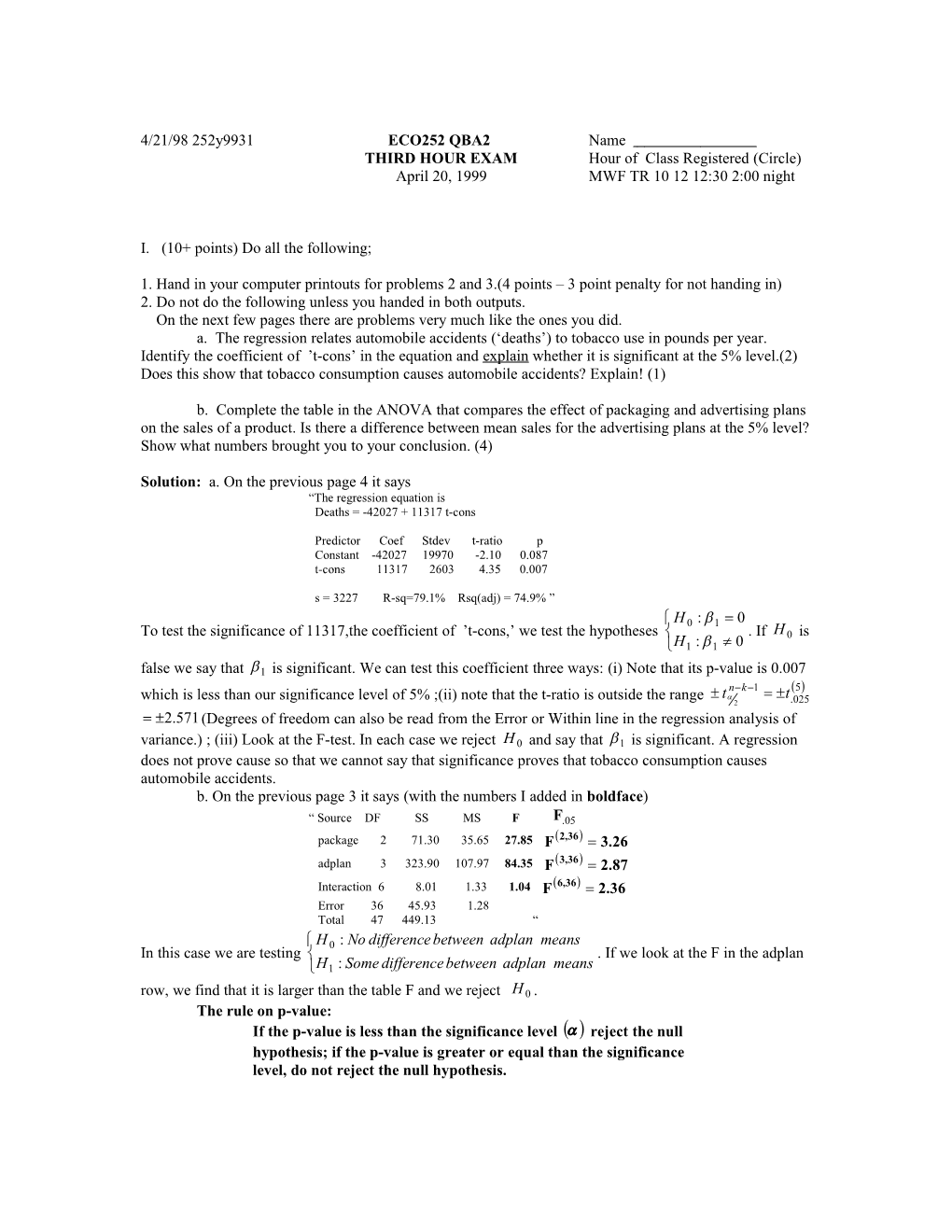
a. The regression relates automobile accidents (‘deaths’) to tobacco use in pounds per year. Identify the coefficient of ’t-cons’ in the equation and explain whether it is significant at the 5% level.(2) Does this show that tobacco consumption causes automobile accidents? Explain! (1)
b. Complete the table in the ANOVA that compares the effect of packaging and advertising plans on the sales of a product. Is there a difference between mean sales for the advertising plans at the 5% level? Show what numbers brought you to your conclusion. (4)
Solution: a. On the previous page 4 it says
“The regression equation is
Deaths = -42027 + 11317 t-cons
Predictor Coef Stdev t-ratio p
Constant -42027 19970 -2.10 0.087
t-cons 11317 2603 4.35 0.007
s = 3227 R-sq=79.1% Rsq(adj) = 74.9% ”
To test the significance of 11317,the coefficient of ’t-cons,’ we test the hypotheses . If is false we say that is significant. We can test this coefficient three ways: (i) Note that its p-value is 0.007 which is less than our significance level of 5% ;(ii) note that the t-ratio is outside the range (Degrees of freedom can also be read from the Error or Within line in the regression analysis of variance.) ; (iii) Look at the F-test. In each case we reject and say that is significant. A regression does not prove cause so that we cannot say that significance proves that tobacco consumption causes automobile accidents.
b. On the previous page 3 it says (with the numbers I added in boldface)
“ Source DF SS MS F
package 2 71.30 35.65 27.85
adplan 3 323.90 107.97 84.35
Interaction 6 8.01 1.33 1.04
Error 36 45.93 1.28
Total 47 449.13 “
In this case we are testing . If we look at the F in the adplan row, we find that it is larger than the table F and we reject .
The rule on p-value:
If the p-value is less than the significance level reject the null
hypothesis; if the p-value is greater or equal than the significance
level, do not reject the null hypothesis.
4/21/98 252y9931
II. Do at least 4 of the following 6 Problems (at least 10 each) (or do sections adding to at least 40 points - Anything extra you do helps, and grades wrap around) . Show your work! State and where applicable.
1. a. In the regression output supplied with this exam.
(i) Add a regression line to the graph. (1)
(ii) Do a 90% confidence interval for the constant in the equation. (2)
(iii) Assuming that there is some sort of valid relationship, what automobile accident rate would you predict for a year in which per capita tobacco consumption was 10 pounds? (2)
b. In the analysis of variance supplied with this exam.
(i) Test for significant interaction – explain your conclusion. Use a 90% confidence level. (2)
(ii) Do a 95% confidence interval for the difference between the means of package 1 and 3
that is
Valid when used alone. (2)
Valid when used with other possible differences between means. (2)
Solution: a. (i) just connect the x’s on former page 5.
(ii) , ( is the number of independent variables.) or –82267 to –1787.
(iii) Deaths = -42027 + 11317 t-cons = -42027 + 11317(10) = 71143.
b. (i) From the previous page. (New F’s provided)
“ Source DF SS MS F
package 2 71.30 35.65 27.85
adplan 3 323.90 107.97 84.35
Interaction 6 8.01 1.33 1.04
Error 36 45.93 1.28
Total 47 449.13 “
All F values are approximate and come from the table on page 1020 of the text. Since the F for
interaction is less than the table value, accept .
(ii) We havecolumns, rows, and observations per cell. From the outline, for individual row means use Bonferroni intervals (with ) . As explained in class, the degrees of freedom for the t statistic are the Error (Within) degrees of freedom, so we want . From the table of means that appeared above the ANOVA table, the mean for package 1 is 28.700 and the mean for package 3 is 25.737. From the table above . Putting this together
For simultaneously valid row means, use the Scheffe’ interval . As explained in class, this amounts to replacing. by , where the degrees of freedom are those used in the F-test for rows above. So .
4/21/98 252y9931
2. Three new employees are to be evaluated by the partners in an accounting firm for the number of errors that they make in each of six statements of varying difficulty. The data appears below. Assuming that the underlying distribution is normal, and noting that it is blocked (classified) by the statement number, compare mean error rates. (13) Note: Note also: If you wish to ignore that the data is blocked by statement, indicate this now and compare the column means assuming that the data is three random samples from a normal distribution.(10).
1st 2nd 3rd
statement employee employee employee
1 2 2 3
2 1 3 4
3 0 1 4
4 4 6 5
5 2 3 4
6 1 4 3
Solution: a) 2-way ANOVA (Blocked by statement) ‘s’ indicates that the null hypothesis is rejected.
Statement / Employee / Sum / / SS /1 / 2 / 2 / 3 / 7 / 3 / 2.3333 / 17 / 5.4444
2 / 1 / 3 / 4 / 8 / 3 / 2.6667 / 26 / 7.1111
3 / 0 / 1 / 4 / 5 / 3 / 1.6667 / 17 / 2.7778
4 / 4 / 6 / 5 / 15 / 3 / 5.0000 / 77 / 25.0000
5 / 2 / 3 / 4 / 9 / 3 / 3.0000 / 29 / 9.0000
6 / 1 / 4 / 3 / 8 / 3 / 2.6667 / 26 / 7.1111
Sum / 10 / + 19 / + 23 / = 52 / 18 / 2.8889 / 192 / 56.4444
6 / + 6 / + 6 / = 18
1.6667 / 3.1667 / 3.8333 / 2.8889
SS / 26 / + 75 / + 91 / 192
2.7778 / + 10.0278 / + 14.6944 / = 27.50
Note that is not a sum, but is . .
. This is in a one way ANOVA.
()
Source
/SS
/DF
/MS
/ / /Rows (Statement) / 19.1111 / 5 / 3.8222 / 4.845 / s / Row means equal
Columns(Employees) / 14.7778 / 2 / 7.3889 / 9.367 / s / Column means equal
Within (Error) / 7.8889 / 10 / 0.7889
Total / 41.7778 / 17
b) One way ANOVA (Not blocked by statement) ()
Source
/SS
/DF
/MS
/ / /Columns(Employees) / 14.7778 / 2 / 7.3889 / 4.105 / s / Column means equal
Within (Error) / 27.0000 / 15 / 1.8000
Total / 41.7778 / 17
4/21/98 252y9931
3. Data from problem 2 is repeated below.
1st 2nd 3rd
statement employee employee employee
1 2 2 3
2 1 3 4
3 0 1 4
4 4 6 5
5 2 3 4
6 1 4 3
a) Assume that the distribution is not normal, but that it is blocked (classified) by statement number, and again compare the distributions represented by the columns. (5)
b) Assume that the distribution is not normal, but that each column is a random sample, and again compare the distributions represented by the columns. (5)
Solution: a) Friedman Test . Rank within rows.
Statement / Employee1 / 2 / 1.5 / 2 / 1.5 / 3 / 3
2 / 1 / 2 / 3 / 2 / 4 / 3
3 / 0 / 2 / 1 / 2 / 4 / 3
4 / 4 / 3 / 6 / 3 / 5 / 2
5 / 2 / 2 / 3 / 2 / 4 / 3
6 / 1 / 3 / 4 / 3 / 3 / 2
Sum / 6.5 / 13.5 / 16
There are rows and columns. Check: the rank sums must add to . Since 6.5 + 13.5 + 16 = 36, we are all right. The Friedman Statistic is According to the Friedman Table () 7 has a p-value of .029 and 8.333 has a p-value of .012, so this p-value must lie in between. If the p-value for our null hypothesis must be below .05, so we reject .
b) Kruskal-Wallis Test Rank within entire group (1 to 18). Then resolve ties by replacing ranks with average ranks as follows: is rank 2, 3 and 4, replace with 3; is rank 5, 6 and 7, replace with 6; is rank 8, 9, 10 and 11, replace with 9.5; is rank 12, 13, 14, 15 and 16, replace with 14. These revised ranks are
Statement / Employee1 / 2 / 5 6 / 2 / 7 6 / 3 / 10 9.5
2 / 1 / 2 3 / 3 / 8 9.5 / 4 / 14 14
3 / 0 / 1 1 / 1 / 4 3 / 4 / 15 14
4 / 4 / 12 14 / 6 / 18 18 / 5 / 17 17
5 / 2 / 6 6 / 3 / 9 9.5 / 4 / 16 14
6 / 1 / 3 3 / 4 / 13 14 / 3 / 11 9.5
Sum / 33 / 60 / 78
4/21/98 252y9931
Check: If there are numbers, the three sums of ranks should add to , as 33, 60 and 78 do. The Kruskal-Wallis statistic has the formula .We cannot use the Kruskall-=Wallis table because the problem is too large, so use a 5% value of with 2 degrees of freedom. The table value is 5.991, so (barely) reject .
Document continues in 252z9931.
5