Top of Form
Bottom of Form
SICK Science®is a registered trademark of Steve Spangler, Inc. All Rights Reserved.
Walking on Eggs EXPERIMENT
1. For a demonstration that is a good warm-up to the the main event, see “Squeeze an Egg Without Breaking It” below.
2. Eggs are amazingly strong, despite their reputation for being so fragile. But, are they strong enough to support the weight of your body? If you just want to attempt the feat of standing on eggs, you’ll only need two cartons of eggs (two dozen eggs). If, however, you’re feeling up to the Walking on Eggshells challenge, pick up six or eight cartons of large-sized eggs.
3. Spread the plastic trash bag (or bags) out on the floor and arrange the egg cartons into two rows on top of them.
4. Inspect all of the eggs to make sure there are no breaks or fractures in any of the eggshells. Make any replacements that might be necessary.
5. It’s important to make sure all of the eggs are oriented the same way in the cartons too. One end of the egg is more “pointy” while the other end is more round. Just make sure that all of the eggs are oriented in the same direction. By doing this, your foot will have a more level surface on which to stand.
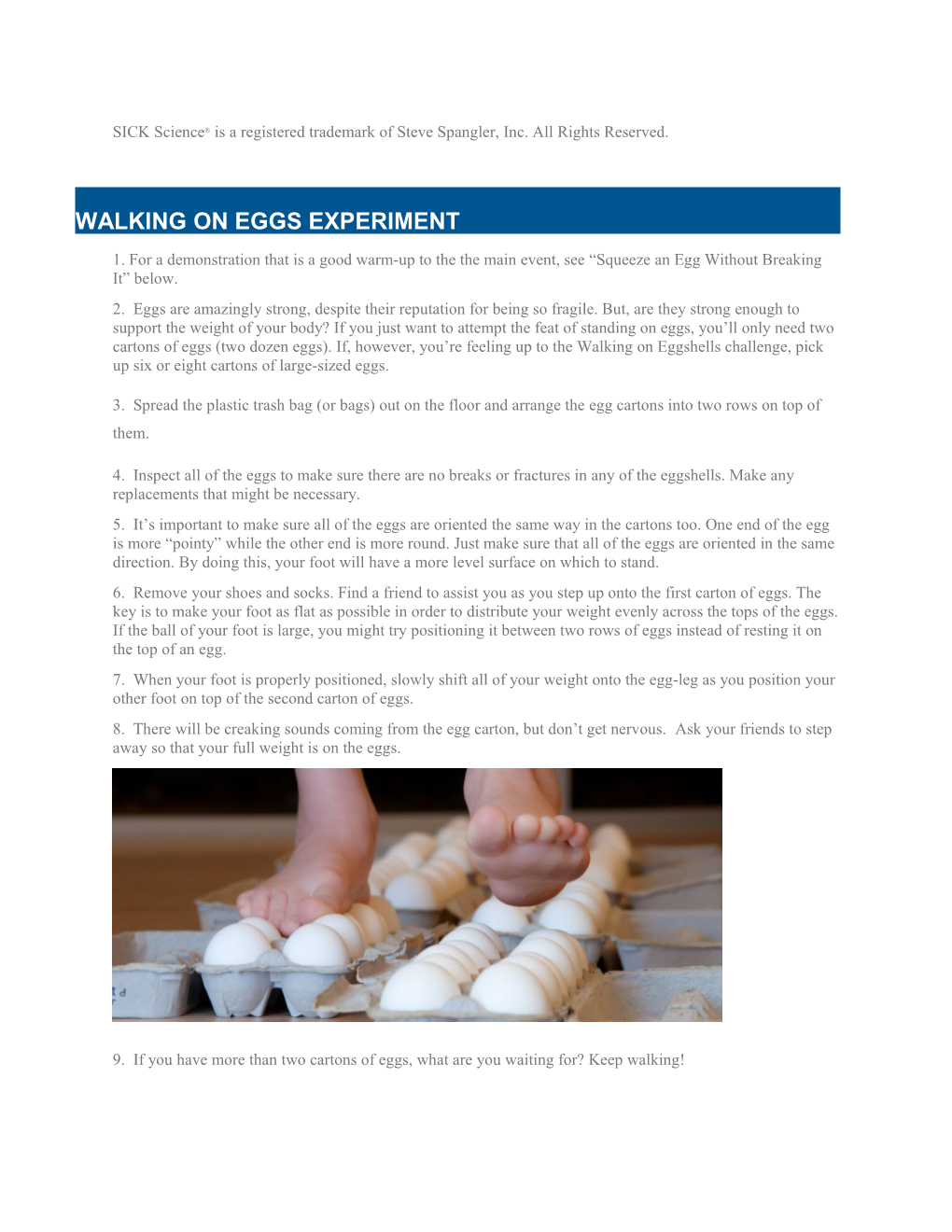
6. Remove your shoes and socks. Find a friend to assist you as you step up onto the first carton of eggs. The key is to make your foot as flat as possible in order to distribute your weight evenly across the tops of the eggs. If the ball of your foot is large, you might try positioning it between two rows of eggs instead of resting it on the top of an egg.
7. When your foot is properly positioned, slowly shift all of your weight onto the egg-leg as you position your other foot on top of the second carton of eggs.
8. There will be creaking sounds coming from the egg carton, but don’t get nervous. Ask your friends to step away so that your full weight is on the eggs.
9. If you have more than two cartons of eggs, what are you waiting for? Keep walking!
HOW DOES IT WORK
Plain and simple, the shape of the egg is the secret! The egg’s unique shape gives it tremendous strength, despite its seeming fragility. Eggs are similar in shape to a three-dimensional arch, one of the strongest architectural forms. The egg is the strongest at the top and the bottom (or at the highest point of the arch). That’s why the egg doesn’t break when you apply pressure evenly to both ends. The curved form of the shell helps to distribute pressure evenly all over the shell rather than concentrating it at any one point. However, eggs do not stand up well to uneven forces, which is why they crack easily on the side of a bowl. This also explains how a hen can sit on an egg and not break it, but a tiny little chick can break through the eggshell. The weight of the hen is evenly distributed over the egg, while the pecking of the chick is an uneven force directed at just one spot on the egg.
If you guessed that the egg carton probably played a role in keeping the eggs from breaking, you’re right. Joseph Coyle is credited as the inventor of the first container made specifically to keep eggs from breaking as they were transported from the local farm to the store. As the story goes, Coyle invented the egg carton in 1911 as a way to solve a dispute between a farmer and a hotel operator who blamed the farmer for delivering broken eggs. Coyle designed a container made out of thick paper with individual divots that supported each egg from the bottom while keeping the eggs separated from one another. As legend has it, the fully loaded egg carton can even be dropped, and if it lands just right, the eggs will survive the fall.
SAFETY INFORMATION
There’s a very high probability that you’ll break a few eggs while attempting to learn this amazing trick. Since raw eggs carry the danger of Salmonella, it’s important that you clean up, wash your hands, and disinfect the area. Even if you don’t break an egg, it’s still a good idea to wash your hands (and feet!) after handling eggs.