1
Supplemental Digital Content # 1
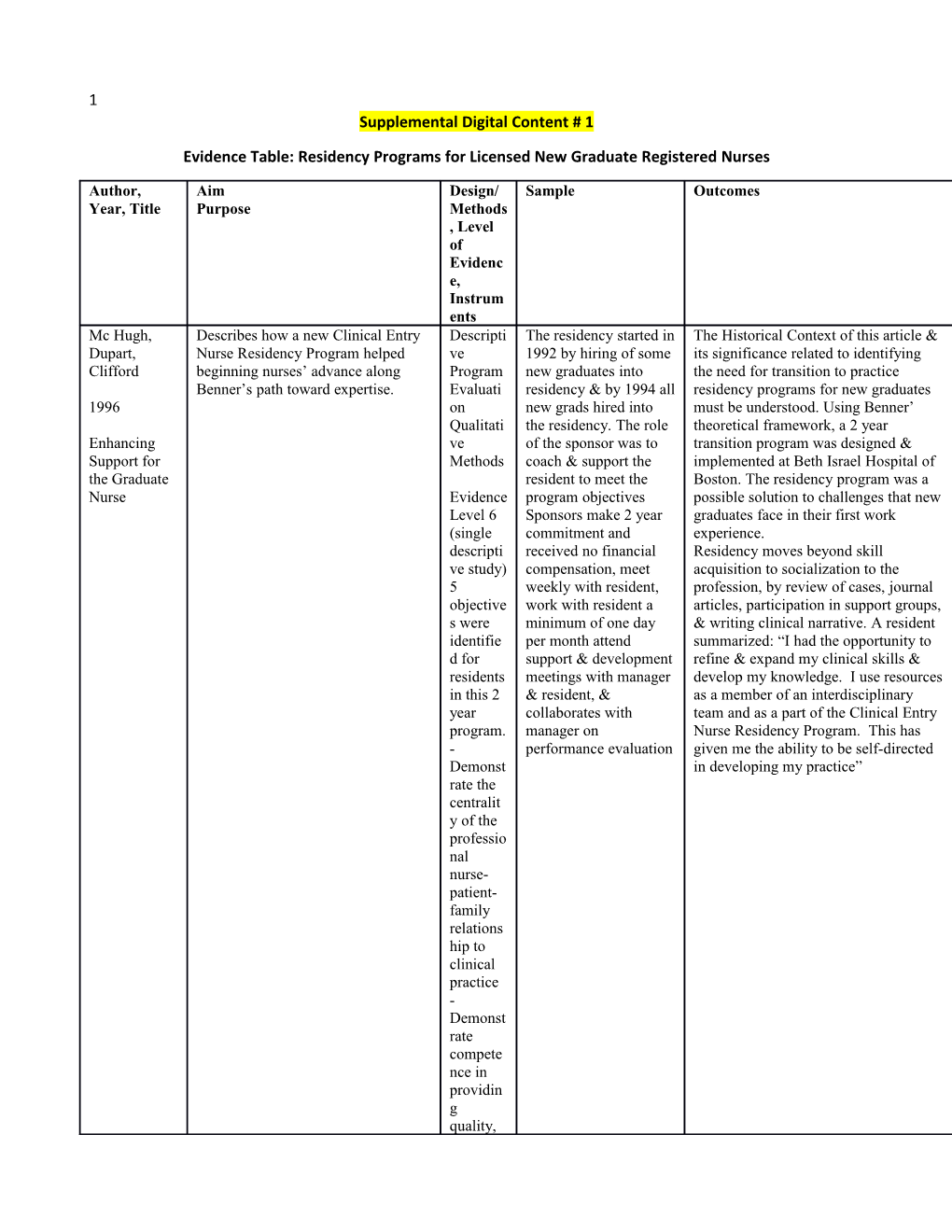
EvidenceTable:ResidencyPrograms for Licensed New Graduate Registered Nurses
Author,Year, Title / Aim
Purpose / Design/Methods, Level of Evidence, Instruments / Sample / Outcomes / Strengths
Limitations
Mc Hugh, Dupart, Clifford
1996
Enhancing Support for the Graduate Nurse / Describes how a new Clinical Entry Nurse Residency Program helped beginning nurses’ advance along Benner’s path toward expertise. / Descriptive
Program Evaluation Qualitative Methods
Evidence Level 6
(single descriptive study)
5 objectives were identified for residents in this 2 year program.
-Demonstrate the centrality of the professional nurse-patient-family relationship to clinical practice
-Demonstrate competence in providing quality, cost effective nursing care
-Demonstrate leadership in all aspects of professional practice
-Formulate a plan for continued development overall career goals
-Appreciate the larger context of the health care delivery system how it affects nurses clinical practice / The residency started in 1992 by hiring of some new graduates into residency by 1994 all new grads hired into theresidency. The role of the sponsor was to coach support the resident to meet the program objectives Sponsors make 2 year commitment and received no financial compensation, meet weekly with resident, work with resident a minimum of one day per month attend support development meetings with manager resident, collaborates with manager on performance evaluation / The Historical Context of this article its significance related to identifying the need for transition to practice residency programs for new graduates must be understood. Using Benner’theoretical framework, a 2 year transition program was designed implemented at Beth Israel Hospital of Boston. The residency program was a possible solution to challenges that new graduates face in their first work experience.
Residency moves beyond skill acquisition to socialization to the profession, by review of cases, journal articles, participation in support groups, & writing clinical narrative.A resident summarized:“I had the opportunity to refine expand my clinical skills develop my knowledge. I use resources as a member of aninterdisciplinary team and as a part of the Clinical Entry Nurse Residency Program. This has given me the ability to be self-directed in developing my practice” / Limitations”
Number of residents per year not provided
Article is not research but an evaluation of a new program how objectives were met.
No control group.
Strengths:
This article laid the groundwork for the need for nurse residency transition to practice programs greatly influenced today’s development of residency programs for new graduates.
New graduates enter residency as advanced beginners & end the 2 year program at “competent level.”
AltierKrsek
2006
Effects of a 1 year Residency Program on Job Satisfaction Retention of New Graduate Nurses / To measure job satisfaction on hire at completion of residency program to measure retention. / Prospective longitudinal design.
Evidence Level 4
(cohort study)
Methods: Comparison of the MMSS Job Satisfaction Instrument scores at hire at completion of one year residency using paired t test.
Instrument administered online.
Retention rate measured by number of students at start divided by number at program completion. / 316 BSN new grads from 6 academic medical centers.
Residency Type--
University HealthSystem Consortium/
American Association Colleges of Nursing (UHC/AACN) one year nurse residency.
111 residents completed the job satisfaction survey on hire on completion. / Subscale--Satisfaction with praise professional opportunities had a statistically significant reduction in scores.Other subscales had minimal change
Satisfaction scores for Non-Whiteresidents (24%) were dissatisfied with their co-workers, interaction opportunities professional opportunities.
Residency retention rate was 87% (275 of 316). / Limitations:
No control group.
Limited to inpatient hospital setting.
This study was for the first year of the UHC/AACN residency (pilot year)
Strengths;
Provided data for program improvement.
Need to increase job satisfaction with residency understand job satisfaction needs of minority students.
Krugman, Bretschenider Horn, Krsek, Moutafis, Smith
2006
The National Post-Baccalaureate Graduate Nurse Residency Program:
A Model for Excellence in Transition to Practice / To describe the UHC/AACN nurse residency structure, curriculum specialty roles responsibilities program evaluation.
Report outcomes form the 6 original pilot sites. / Descriptive Longitudinal
Evidence Level 4
(cohort study)
Hospital Educators responsible for implementation of the UHC/AACN nurse residency a UHC Director describe the development outcomes of a national post-baccalaureate nurse residency program.
Outcomes from the original 6 pilot sites were measured using the Gerber Control Over Practice, the McCloskey Mueller Satisfaction Scale, the Casey- Fink Graduate Nurse Experience Survey & the Resident Program Evaluation Instrument / N not reported. Six academic medical centers reported outcome data for the pilot post-baccalaureate nurse residency
Residents were primarily women (92%) and Caucasian (75%) with a mean age of 25 years. / Turnover rate in pilot sites was 8%.
Residents rated high in control over practice on hire with a decline at 6 months increase at end. Of the eight domains of the satisfaction scale, professional interaction opportunities are reported due to it being a key retention element. Results show positive satisfaction.
Reported stress was high on start of program decreased over time-- organizing prioritizing outcomes reported improvement over time
One pilot site (egrets) had significant less positive views of the residency than other sites due to the lack of monthly support sessions lack of a cohort group. This speaks to importance of the cohort group role monthly support sessions. The Egret program is under revision in light of these findings / Limitations:
A pilot program
No control group for comparison.
N not reported for outcome measures
Strengths:
Provides strong description of the residency its components importance of following curriculum how scores decline when curriculum not followed
Research outcomes strongly indicate transition into practice is not completed until 9 to 12 months after hire.
Beecroft, Dorey & Wenten
2007
Turnover Intention in New Graduate Nurses: A Multivariate Analysis / Determine relationship of new nurse graduate turnover intent with:
individual
characteristics, work environment variables, organization factors and compare turnover intent with actual turnover 18 months post residency / ProspectiveLongitudinal Survey Design.
Evidence Level 4
(multiyear cohort study)
Data collected from 1999 to 2006
Instruments/scales:Self Confidence Survey, Slater Competencies Rating, Nursing Role Conception, Ways of Coping.Work environment measures:
Conditions for Work Effectiveness Questionnaire,
Professional Nurse Autonomy Clinical Decision Making Work Satisfaction, Nurse Job Satisfaction,Organizational Factors Measures, Leader Empowerment Behaviors, Group Cohesion and Organization Commitment
Turnover intention measured with single item scale actual turnover by records / 889 pediatric nurses who completed the same standardized 22 week nurse residency
All hospitals were not for profit similar in size.
Hospitals that submitted data on 50 or more respondents with at least a one year follow up were included. / Younger respondents those with higher level of education more likely to indicate turnover intent.
Older respondents (>30) 4.5 times more likely to have turnover intent if they did not get their ward choice.
Higher scores on work environment organizational characteristics contributed to the nurse not being in the turnover intent group.
Factors listed above distinguished turnover intent 79% of the time.
Nurse seeking increased social support to cope with transition is related to turnover intent.
Lower scores on skills self-confidence and perceptions of nursing competence contributed to turnover intent. / Limitations:
Another variable to measure stress level during transition could help explain link between increase in seeking social support turnover intent
Response rate not reported.
Strengths:
Number of measures used to determine results
Findings indicate turnover has impact on patient safety health outcomes.
Findings indicate when new graduates are satisfied with their jobs pay feel committed to the organization, the odds against turnover intent decrease.
Newhouse, Hoffman Suflita, Hairston
2007
Evaluating an Innovative Program to Improve New Nurse Graduate Socialization Into the Acute Healthcare Setting / Test whether the internship program, “Social Professional Reality Integration for Nurse Graduates” (SPRING) improves new nurse graduate retention, sense of belonging, organizational commitment anticipated turnover. / Quasi-experimental, posttest only, control group design.
Evidence Level 4
Theoretical Basis for Study-Donabedian’sstructure, process outcomes
Research Questions:
1. Is there a difference in organizational commitment, sense of belonging anticipated turnover for new graduates who complete the SPRING internship program in comparison with new graduates who do not complete the SPRING program?
2. Does participation in SPRING result in higher retention of new nurse graduates than those who do not attend SPRING?
Measurement instruments: Organizational Commitment Questionnaire;
Modified Hagerty-Patusky Sense of Belonging ;Anticipated Turnover Scale / N for the 3 comparison groups: baseline 159, 6 months 321, 12 months, 304.
Intervention measured over a three year period.
Baseline—control group hired in 2001- consisted of one department.
SPRING groups hired May 2002 through December 2005.
Survey’s distributed at baseline, 6 months 12 months.
Response rates for surveys were 46% baseline, 74% 6 months 70% 12 months. / Means generally high for sense of belonging antecedents psychological concepts organizational commitment.Anticipated turnover means varied with psychological sense of belonging perceptions decreasing at 6 months and increasing at 12 months.Outcomes from question 1:No differences in organizational commitment between times. There was a difference for anticipated turnover with baseline nurses being more likely to consider leaving their positions then 6 month SPRING nurses. SPRING graduates have higher retention rates at 12 month than non-SPRING grads.Significant difference in 6 month Spring respondents baseline 12 month SPRING respondents---with 6 month nurses having a lower antecedent sense of belonging.
Outcomes from Question 2:
Significant differences with 12 month retention between the SPRING group the comparison group chi square= 6.032, p=.014, the SPRING graduates were higher descriptively for both 18 24 months but not statistically significant / Limitations;
Baseline data were gathered from nurses with less than 1 year experience. N for baseline nurses who did not complete Spring not clear.
Baseline subjects were from multiple units with their own clinical orientation programs.
Baseline data had low response rate.
Nurse characteristics not included so no relationship established with nurse characteristics.
Strengths:
Program included targeted education, social support, group exercises needs-driven dialogue exchange of ideas to meet new graduate needs was effective in the first year of employment in improving nurse retention
Pine & Tart
2007
Return on Investment: Benefits Challenges of a Baccalaureate Nurse Residency Program / Make a positive change in turnover rates of new graduates by implementing theUHC/AACN nurse residency program. / Descriptive
Evidence Level 4
(cohort study)
Assist new nurse graduates in transitioning from the role of advanced beginner to competent nurse.
Calculate residency program costs return on investment with implementation of the residency program compared to traditional on boarding. / 48 residents in UHC/AACN
Determine return on investment with implementation of the residency program.
Compare turnover rate of 50% in new graduates to turnover rate after implementing the UHC/AACN residency program. / The Return on Investment (ROI) was calculated based on comparing the traditional method of bringing new graduates to the facility having a 50% turnover rate to the new method using the UHC/ACCN a 13% turnover rate.
Traditional method costs were $1,372,800, the new method costs using the UHC/ACCN residency was $274,560. A savings of $1,098,240 for years 2004-2005. / Limitations:
Results from one hospital only saving dependent on local salaries for nurses
Strengths:
Documents how program costs are greatly impacted by turnover costs. Provides methodology for calculating savings
Williams, Goode, Krsek, Bednash & Lynn
2007
Baccalaureate Nurse Residency 1-Year Outcomes / Document 1 year outcomes from UHC/ACCN residency program.
Determine turnover rate for residency program. / Descriptive, longitudinal study
Repeated Measures Design
Evidence Level 4
(cohort study)
ANOVA used to compare scale scores on hire, at 6 months one year. Program components:Evidence-based core curriculum, nurse preceptor, access to a facilitator for professional role development guidance.
Turnover Rate = residents entering program number completing.
Instruments:
Casey/Fink Graduate Nurse Experience, Gerber, Control over Practice, McCloskey Mueller Satisfaction
Questions developed by UHC/AACN taskforce for
Evaluation of Program: satisfaction with recruitment & welcome, with program topics, overall program goals, professional growth, satisfaction with faculty. / N= 679 residents
12 academic medical center acute care hospitals
Data from first 2 cohorts who used the UHC/AACN Residency Curriculum.
Curriculum based on research studies of new graduates’ transition to practice needs
Sample-BSN new graduates had mean age 25.16 to 25.55. Alpha group had 7% male Beta had 12% male
Beta residents more diverse with34% compared to 17% in Alpha. / Casey/Fink instrument results: increases from program entry to exit in the total score, in ability to organize and prioritize, and in communication leadership subscales.
Gerber’s scale demonstrated a V shape pattern with mean at entry exit higher than the mean at 6 months. Overall, data on the CONP show a pattern of perceived growth.
The MMSS job satisfaction showed a statistically significant decline from hire to six months scores beginning to recover atprogram end.
Turnover rate was 12%- compared to35% to 55% reported in the literature. Residents who are younger, had lower GPA’s, were less content with their experience professional satisfaction were more likely to be in the termination group.Residents’ view of the 1 year program: means ranged from3.07 to a high of 3.26 on a 4 point scale.
Data suggest residencies that are less than a year may not provide sufficient time for resident successful transition to practice. / Limitations:
No Control Group
Unable to control for site related variables which could influence results.
Strengths:
Curriculum evidence-based designed for transition to practice for BSN new graduates.
Research provided data to revise measurements.
Research provided data for decision to expand residency to more sites.
Consistent emergence of the decline in scores at 6 months, suggest new graduates may be vulnerable at this time period.
Fink, Krugman, Casey, Goode
2008
The Graduate Nurse Experience: Qualitative Residency Program Outcomes / Aim-- Evaluate qualitative responses to the Casey-Fink Graduate Nurse Experience Survey. / Qualitative Study
Evidence Level 6
Survey Administered to graduate nurse residents in the UHC/AACN Post Baccalaureate Nurse Residency Program.
Report of qualitative data from 2 cohorts in the UHC/AACN post baccalaureate nurse residency program
Analysis included 5 open ended questions, where residents could voice their experiences about the work environments & role transition. The questions included: skill and procedures residents uncomfortable performing, stressors, transition difficulties, and support and integration.
Key Words from respondents were independently identified by 2 investigators & validated by co-authors. / 434 residents who completed the surveys for all 3 time periods (on hire, six months, & one year—41% response rate
12 academic medical center hospitals.
Average respondent was 26 year old Caucasian women with BSN degree.
No statistical differences in demographic outcomes related to number of preceptors, length of orientation, and work in health field before coming a resident or area of clinical practice. / Top 3 Skills & Procedures Residents Uncomfortable Performing:
On Hire (IV starts, blood draws, assessment skills) At Six Months (IV starts, codes/ emergency response arterial, venous, Swan Ganz) At OneYear(Code and emergency responses, IV starts, Trach care.)Stressors Reported:Adjusting to independent life style, expectations of the work environment & new RN role, and family responsibilities.
Transition Difficulties: At 1 year, 42% of resident’s still perceived difficulties. 5 overall themes emerged: 1.Role changes, 2 Lack of confidence, 3.Workload/organizing & prioritizing, 4.Fears/patient safety/harming, 5.Orientation Issues--learning unit technology, information overload, multiple preceptors, and choice of unit.
Manager Support & feedback was identified as one of top ways they could have felt more supported along with consistent preceptors.Open ended comments: Residents liked support from peers, Position would have been overwhelming without residency / Limitations:
Numbers of qualitative comments diminished over the 3 time periods. Could indicate measurement fatigue
Strengths:
Qualitative data added to the body of evidence regarding residency programs
Data from study used to revise the research instrument.
Data from study used to focus skills labs
Residents identified the need to develop skills & confidence in directing assistive personnel. Residents requested the desire to have a resource person or mentor during the last 6 months of practice.
Goode, Lynn, Krsek, Bednash
2009
Nurse Residency Programs: An Essential Requirement for Nursing / Analysis of outcomes from BSN residents who completed UHC/AACN instruments on hire,at 6months,1 year for 2004-2005
Build the case for residency accreditation
Present need for CMS to support accredited residencies with pass through dollars. / Descriptive, Repeated measures Design
Evidence Level 4
(cohort study)
ANOVA used to compare scores over time. Evaluation of a one year residency offered by a hospital & a school of nursing. Instruments used to measure outcomes-The Casey/Fink Graduate Nurse Experience, Gerber Control over Practice; McCloskey Mueller RN Job Satisfaction & a Program Evaluation Scale developed by research team.
The least significant difference procedure for post hoc comparison used to identify significant differences between the data collection periods. / 665 residents from 26 academic medical center hospitals; 46% response rate.
Residents hired from September 2004 & September 2005.
Mean age of residents 25.6 years with 9.2% males. 27.9% had a baccalaureate or higher degree in another field.
Sample included 75.9% Caucasian/